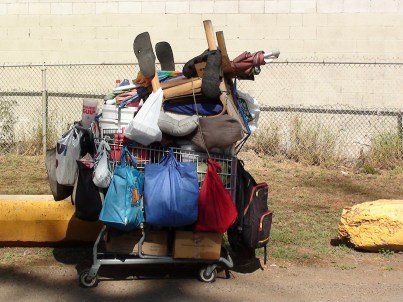
During my shift at the food pantry this week we packed food for a homeless man. He was very young, not much more than a boy actually. He came to us because he was desperate and hungry. He had a job, although he hadn’t had it for long. He didn’t have a car, so he walked over 3.5 miles each way to work, taking him over an hour. We packed  him what we could, considering he didn’t have a refrigerator or any way to cook or warm his food. What we gave him was a mish mash and not much of it was very healthy. He said he would take anything we had to give, because he was really hungry. We gave him SPAM, Vienna sausages, sardines, saltines, granola bars, tuna fish, peanut butter and a couple tiny jars of jelly. We were also able to give him canned fruit, applesauce and beef stew and Chef Boyardee products (to be eaten cold). All of these items had to have pop tops or foil tops because he doesn’t have a can opener. Luckily we were able to give him some fresh grapefruit and apples. We were also lucky that someone had donated a package of plastic forks, so we were able to give him something with which to eat. He was fortunate to have a ride, which meant we were able to give him several bags of food. If he had been walking we would have only been able to give him what he could carry.
Hopefully this young man’s life is beginning to turn around. Hopefully he maintains his temp. job and it turns into a permanent position. For him, this I hope, but here’s something I know. I have packed food for other employees, permanent, full time employees who work for the same employer where this young man is currently temping. So while I hope for a better future for this young man, I am not overly optimistic I will never see him at the food pantry again. The plight of this you man and all the other people who are working full time jobs, yet still need SNAP, housing subsidies, Medicaid or food from a food pantry, clearly illustrates why the minimum wage needs to be raised to a living wage. The current minimum wage of $7.25/hour barely keeps a single person without dependents, working 40 hours per week, above the poverty line. Raising the minimum wage to the proposed $10.10/hour will only keep a 3 person household, say a single mom and 2 children, at the poverty line. It is only when the minimum wage approaches $12-$15/hour that we see households begin to inch away from the poverty line.

At the mention of a living wage, some will argue that it is a burden to small businesses and quite possibly for truly small businesses this may be true in many cases. My family operated a small business for many years and employees were paid minimum wage. It is quite possible that if my parents had had to pay their employees more per hour that all employees hours would have been cut or that they may have been forced to let someone go. However, the minimum wage those employees took home was worth more than today’s minimum wage. The minimum wage has not kept up with inflation. When my parent’s began operating their business in 1978, the minimum wage was $2.65/hour. When that salary is adjusted to today’s dollars it equals $9.14/hour. Today’s minimum wage is $7.25/hour, which is almost $2.00/hour less than the 1978 minimum wage adjusted to today’s dollars. The minimum wage in 1978 went farther, paid more bills, than the minimum wage of today. Furthermore, many of the businesses paying employees today’s low minimum wage are large companies which boast sizeable yearly profits and are often run by CEOs who earn exorbitant salaries, suggesting these companies have the resources to increase their employees’ salaries.
Another common argument against raising the minimum wage to a living wage is that it will kill jobs. Workers will be laid off and employers will be unable to hire employees, causing a stagnate job market. Most economists used to believe that raising the minimum wage would have a negative effect on employment until the Card-Kruger study conducted in the early 1990s, which found a surprisingly positive effect. Additionally, former Labor Secretary, Robert Reich, points out that raising the minimum wage puts money directly into the pockets of people who are going to spend that money, mostly in the local economy. That infusion of money into the economy creates a greater demand for goods and services, resulting in job creation.
 So, what happens when employers do not pay their employees a living wage? Many of those employees are forced to turn to the government for assistance in the form of SNAP, Medicaid and housing and child care subsidies, forcing the U. S. taxpayer to make up the difference caused by their low wages. According to an article by Clare O’Connor on Forbes.com, Walmart and McDonald’s cost U. S. taxpayers an estimated $6.2 billion and $1.2 billion, respectively, in public assistance because their workforce must turn to these social safety net programs in order to make ends meet. At one point, McDonald’s even assisted it’s employees in signing up for public assistance programs, because they knew their low wages would not provide enough income for their workers to live on. As a result of their employees receiving so much in public assistance benefits, Barry Ritholtz, in an article on the website Bloomberg View, labeled Walmart and McDonald’s as America’s largest and most undeserving welfare queens.
Many people in poverty are employed. The homeless man I packed food for on Tuesday has a job. Others are retail sales clerks, home health aides, janitorial staff and factory and warehouse workers. They are performing often physically demanding jobs, doing tasks  that make many of our lives easier, like picking our produce, caring for our children or elderly and ailing parents or cleaning our office buildings. As Robert Reich so astutely stated when advocating for a living wage, “People who work full time are fulfilling their most basic social responsibility. As such, they should earn enough to live on.” Raising the minimum wage to a living wage will not only restore dignity to America’s working poor, but it will stimulate the economy and assist in moving more Americans off of assistance and out of poverty.
Note: A local paper reported this week that Walmart will be giving raises to all associates hired before January 1, 2016. The average salary for full time associates after the raise will be $13.31. The pay increase is part of a two year commitment, on the part of Walmart, toward higher pay, more effective training, clearer career paths and increased educational opportunities for workers. This commitment is projected to cost Walmart $2.7 billion.



 exist. The U.S. Census bureau’s poverty threshold in 2015 for a family of 3 (single mother and 2 children) is a salary of approximately $19,000 per year. Households of that size earning less than $19,000 per year are considered to be living in poverty. The next level of poverty is deep poverty which is defined as having a household cash income under half the poverty threshold. Using the 2015 poverty threshold, that same family of three living in deep poverty would have an annual salary of only about 9,500 dollars. The most dire level of poverty is aptly named extreme poverty and to fall into this category households exist on $2.00 or less in cash income per person per day. For that same household of three living in extreme poverty, their annual salary would be a paltry 2,190 dollars.
 cities. As it happens, Philadelphia, located about an hour from my home, has the highest rate of deep poverty of any of the 10 most populous cities in the United States. Philadelphia’s deep poverty rate is 12.2%, or approximately 185,000 people, including 60,000 children, which is almost twice the U.S deep poverty rate. While the deep poverty rate seem to be declining slightly in metropolitan areas, the non-metro, rural areas have not seen much if any decline.
 Unfortunately, many can not find a job because the jobs are not there or they lack the necessary skills. Others are unable to keep jobs they do find, because employers are unsympathetic to transportation problems, child care issues, illness and an inability to respond to erratic schedules that change at the last minute. Additionally, many researchers and scholars believe the rise in extreme and deep poverty rates is a consequence of the 1996 welfare reforms, which instituted work requirements and lifetime benefit limits. As Kathryn Edin suggest, when you pair the 1996 welfare reforms with the decline in job opportunities at the very bottom of the job market, the inevitable result will be a rise in deep and extreme poverty.
 I am always disconcerted when I hear someone discussing or read a statement suggesting that people in poverty who are receiving government assistance are undeserving of their benefits or are choosing to live the easy life on welfare instead of working for a living. Encountering these various statements one too many times is actually why I decided to start this journey to help the food insecure and advocate for the poor. During the past couple of weeks I have been confronted more frequently than normal with this sentiment, so I feel it is important to respond to the notion that living comfortably on welfare is a lifestyle choice or even possible. What many refer to as welfare, cash assistance from the government, dramatically changed in 1996 with the enactment of the Personal Responsibility and Work Opportunity Reconciliation Act (PRWORA). Not only has welfare been reformed, but in recent years cuts in funding to other programs that make up the social safety net have resulted in reductions in either benefit amounts or the number of eligible people receiving benefits. The changes brought about through reform, coupled with funding cuts in safety net programs, have greatly changed the landscape of what is collectively called welfare.
 the largest of the 15 nutrition programs administered by the federal government. It is a mandatory or entitlement program which means the federal government is required to fund benefits for all eligible recipients. Additionally, this program does not have a lifetime limit on receiving benefits for most recipients. The only exception being able bodied adults without children (
 housing assistance programs have experienced funding reductions, resulting in long waiting lists with some people reporting being on a waiting list for 10 years before receiving any assistance. Furthermore, it is estimated that only 1/4 of eligible recipients ever receive any subsidy. Like housing subsidies, child care subsidy programs have experienced funding cuts resulting in lengthy waiting lists and a reduction in benefits. Additionally, when a subsidy for child care is awards it is often a pittance, unable to begin to cover the actual cost of childcare.
 difficult. Less assistance is available due to budget cuts and more restrictions on getting assistance have been put into place, including lifetime limits for some types of assistance or recipient groups. The reduction in welfare caseloads has been touted as proof of successful reform. In spite of the dramatic reduction in welfare caseloads, however, welfare reform has done little to reduce poverty and may be responsible for the increase in the number of people in the United States experiencing extreme poverty. Americans receiving welfare, in any of its forms, are not living on easy street, and if you asked them, they would almost certainly rather receive a paycheck from a stable, good paying job over receiving welfare.
 work or training program for at least 20 hours per week.
 Some are homeless or living temporarily with friends or family and move around frequently. One third of them have mental or physical limitations, like PTSD, learning disabilities or physical injuries, which are not severe enough to qualify them for disability benefits, but may still limit their ability to work more than 20 hours per week. Among those facing this particular barrier are veterans. Although labeled as childless, that distinction just means they are not the legal custodians of any children they may have. Nearly 25% of these childless adults are non-custodial parents and another 13% are caregivers for a parent, relative or friend. Almost half of childless adults do not have access to reliable transportation or public transportation and 60% lack a valid driver’s license. Finally, more than one third have felony convictions, and even though they have served their time, background checks are difficult to pass. The current job market in the United States is on the rebound, but when you have one of the above mentioned barriers in your way finding a job becomes that much harder. Some childless adults, however, probably face more than one barrier.
 to deny them food assistance, averaging $150-$170 per person, per month? These childless adults, by and large, do not qualify for any other assistance programs from the government. As research from the early 2000s, when this restriction was last enforced shows, many ABAWDs eventually found employment, but at very low wages. They continued to have housing problems, trouble paying their utility bills and struggle to acquire adequate food. In other words many remained extremely poor. Our social safety net has gaping holes in it through which these individuals are falling. In the end, while these measures lessen the number of people receiving public assistance, they only exacerbate the problem of poverty, because the true story is that most people in poverty are there because they are facing actual hardships and they need real assistance of some sort to lift themselves out of poverty.
 political traditions. This motto aided in the creation of Poland’s 1505 constitutional legislation, which transferred political power from the monarchy to parliament. It also sounds very similar to, and perhaps inspired the creation of, the American Revolutionary War demand “No taxation without representation!” More recently the phrase was used the 1990s in the disabilities rights movement. The ancient phrase expresses the equally age old notion of self-determination, that people want to control their own lives.
 who run food banks invited some of their clients in to talk with them and other community leaders about the problems they are facing? And not just food related problems, but all of the problems they face. What if emergency food providers and other community leaders listened to them as they discussed their problems and believed they were the experts on their problems, including the solutions? What if after that meeting, clients, emergency food providers and community leaders collaborated, using the ideas of the clients coupled with the resources of the community, to address some of these problems? I think all parties involved would be surprised at what might be accomplished. I also think we would see stronger communities, as divisions decrease and understanding and respect grows.
 societal safety net programs. This article caused him to ask the question “Who is the typical person receiving welfare?” We have since had a few conversations on both the topic of why some people are voting against their own best interests and who the typical public assistance recipient is. When we have a minute or two, both of us have been searching for an answers to his question.
 Supplemental Nutrition Assistance Program (SNAP). She was forced to give up the WIC benefits because she lacked daycare for her kids so that she could attend the classes required by the program. Her SNAP benefits took 6 months to get because of a delay due to an in-house paperwork backup. In the end, her SNAP benefit is so low she is still forced to go to a food pantry monthly to have enough food for her family.
 been waiting 18 months to see a specialist. The receptionist confided in her that he would probably never see the specialist, because privately insured patients would constantly be moved ahead of him.
 free during the school year, lose that access they are more likely to rely on cheap, calorie dense foods which provide little nutritious value. This switch in diet can lead to a weight gain in the summer among food insecure children that is two to three times higher than their weight gain during the school year. Providing nutritious summer lunches in place of cheap, calorie dense foods can mitigate this weight gain and reduce the susceptibility to chronic diseases like, asthma, type 2 diabetes and heart disease for these children. Additionally, decreasing food insecurity can lessen rates of mental illness and risk of hospitalization for chronic diseases.
 most evident in reading achievement. According to the study having enough nutritious food to eat helps combat cognitive decline which can lessen summer learning loss. Decrease in summer slide can save schools significant funds, as it is estimated to cost $1,540 per student to re-teach a student struggling with summer learning loss.
 Impact Analysis, schools offering a summer lunch program experienced a 5.3% increase in students graduating from high school. As high school graduates typically earn approximately $10,090 more per year than non graduates and experience a 4% higher employment rate, these summer lunch programs will not only beneficially impact the student who graduates, but will also serve to strengthen the economy in the long term, as these students are better able to be productive members of society.
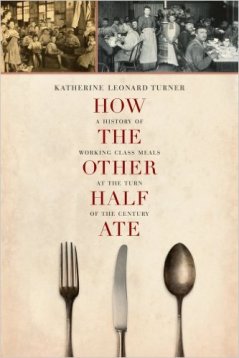 I recently read the book,


 From a Simmer to a Boil