“I don’t need this. Give it to someone who does.”
I heard this, or something very close to it, said three times this week while I was volunteering at the food pantry. The three people who said this were not folks who had come in to donate food. They were three clients who were receiving food. Each one of these clients declined to take at least one item we were offering in their monthly allotment of food, not because s/he didn’t like it, but because it was not needed this month. One lady, when she realized she had a couple of items she did not need, even brought those items back in to us after taking her food to her car . (She also brought in a bag of children’s books to share with others because her children were done with them.) The items they declined were dry good items–a jar of jelly, cans of vegetables, syrup–that would have lasted on a shelf for several months to a year or two, and yet these people, who have so little, refused to take what they did not immediately need so that someone else who needed it more could have it.
I’m not writing about these three clients because their actions are unusual. On the contrary, we hear this sentiment all the time. I am often touched by the generosity of people who have little to share making sure others, who have less, are able to have something as well. And their generosity does not end with just food. I recently learned of two client households who opened their homes to one or more persons who were going to find themselves homeless otherwise. Can you imagine if your resources were already stretched to the breaking point, telling more people to “Come on in. We’ll figure it out somehow.”? I am so touched by their acts of selflessness and glad that we are here to help them as they help others.
Coming to a food pantry is often a last resort for people. They need help, but are usually embarrassed by their need. Once they receive that assistance, they are so appreciative. The situation is no different with our clients. In addition to being thoughtful, the majority of our clients are extremely grateful for our assistance, often to the point of tears. They appreciate the dry good staples we regularly provide, but are especially enthusiastic  about the fresh produce and the little extras we sometimes have, like dog food, special dietary items like low sodium soups and the baking mixes in December. It has been so rewarding to hear how much of a lift those mixes were. One client, in relating how grateful she was to receive the baking mix told us she used the item she baked as a gift from someone. Once again, these stories and thank yous are not unusual, but the norm.
So often the portrayal of people who are at or below the poverty line, and are therefore food insecure, is less than favorable. I have heard people refer to those needing assistance as lazy and that they are cheating the system. One politician called them takers. To be fair, he has apologized for using that term and has since stopped using it, but the sentiment he expressed is alive and well in our country. The reality of who a typical food pantry client is, however, resembles someone far different. The typical food pantry client is the young man who left college in his third year to return home to care for his ailing mother because he was all she had. It is the grandmother who is now caring for her grandchildren and maybe even an adult child, because drug addiction has devastated their family. It is the person struggling to beat cancer or the senior citizen who can’t quite get by on just Social Security. It is even the family trying to make ends meet on one, two or even three minimum wage jobs. Time and again I am humbled by their words of gratitude and simple acts of generosity for others. They understand more than most what it is like to need help and more importantly, how important it is that others are there to provide that help.
 Brrrrr! It’s really cold out, and although the forecast calls for warmer temperatures over the next few days there can be no doubt that winter is here for the next several weeks. As the temperatures have dipped down I find myself trying to stay warm with a hot beverage, either coffee or tea. When the kids came in from enjoying the weekend snow, I warmed them up with yummy cups of hot chocolate. I’m not the only one turning to warm beverages. Over the past few weeks at the food pantry I also noticed some of the clients, especially the homeless, asking if we happen to have anything on hand with which to make hot beverages–tea, coffee or hot chocolate. These are items we do not stock, but every now and then someone will donate some to us. When we are able to include one of these hot beverages in a household’s monthly food supply, it is always much appreciated.
 another drive for February. I always like to look for ways to make February fun. By the beginning of February, the cold and early night fall that comes with winter have cast a gloom over me. I always tell myself if I can make it through February, winter’s spell will be almost over. Plus it’s my birthday month and who doesn’t want to have fun during their birthday month. So, to help make February fun and break winter’s spell I want to warm our client’s hearts with hot beverages. For every household coming in for food in February, I would like for the food pantry to be able to give them a canister of ground coffee, box of tea bags or box of hot chocolate mix. To do this we will need your help again. I will leave the size of the canister or box up to you. We have households ranging from one person to nine people. Even though we all have our own favorite flavor of tea or coffee, please keep donations to either regular coffee or black tea and hot chocolate mixes that require only adding hot water.
 The trend currently exists in coffee shops to pay it forward, whether it is paying for the coffee of the person behind you at the drive thru or buying a community cup of coffee that someone coming in after you leave can use. Think of this as another way to pay it forward. For the price you spend on a specialty coffee at Starbucks or Dunkin Donuts, you could purchase a can of coffee or a box of tea bags or hot chocolate mix to warm someone’s heart. For my local readers, I am happy to pick up items from you and for my farther away readers, like last time, I am happy to purchase items if you want to send a cash donation. Thank you so much for your generosity. Now speaking of hot beverages, it’s tea time!
 The year 2016 is coming to and end and what a year it has been. Before I take a few days off to enjoy Christmas and the New Year festivities with my family and friends, I wanted to reflect a bit on my journey assisting the food insecure this year. This past year contained some positive highlights. Nationally, the US Census Bureau reported in September that the poverty rate in the US declined in 2015 for the first time since 1999. In my community, the local school district started offering free lunch during the summer to all school age children in our community through the Summer Food Service Program. Online I found the
  was very rewarding to me and the other volunteers and staff who pack food for clients to see the happiness and excitement elicited by these unexpected treats. I want to extend a heartfelt thank you to all my friends, neighbors, family and readers who helped make this possible.
 So as 2016 comes to an end I am trying to remain that same optimist who has always tried to find the silver lining. Up until now, however, I never realized how close the colors sliver and gray were to each other. My husband keeps reminding me to focus on my sphere of influence–poverty, and in particular food insecurity–so as to not get overwhelmed by the magnitude of change that may be headed our way. It is good advice and I intend to try to follow it as best as I can. I will continue to advocate and do whatever else I can for those who are struggling to make ends meet and are experiencing food insecurity. I will also continue to encourage meaningful dialogue from all points of view with this blog. Thank you to my readers and to those who comment, either here on the blog or on Facebook or even in person. I have received inspiration, insight and encouragement from your words. And again, thank you so much to those who helped us brighten a few families’ holiday by donating baking mixes!
 Every year my sister and I get together and bake Christmas cookies. It is one of my favorite activities over the holiday season. We light a fire in the fireplace and play Christmas carols all day. As the aroma of freshly baked cookies begins to waft through the house my kids and husband follow the smell to the kitchen to sample a still warm cookie or four. Many of these cookies will find their way to others as gifts–a little thank you to the mailman or the neighbors who can always be counted on for last minute items or pet assistance. The cookies spread cheer to my husband’s employees and the people who work at the agency that houses the food cupboard. As the rush and demands of the holiday season begin to encroach I always make sure I save a day for this event sometimes knowing that I will miss something else.
 like quick breads or brownies, especially ones geared for the holiday season, for instance gingerbread or pumpkin bread or brownies with seasonal add ins. I couldn’t find it in my grocery store, but I’m pretty sure Ghirardelli had a chocolate peppermint brownie mix out over the holiday season last year. Not every packaged mix will work, however. I am looking for mixes which only need the added ingredients of eggs, water and oil. These added items–eggs and cooking oil–are regularly provided by the pantry. I had initially been thinking of getting cookie mixes, but most of those require a stick of butter or margarine and many food insecure households just don’t have that luxury. I did find that the peanut butter cookie mix from Duncan Hines does not call for butter, so it is okay. Lastly, the donations must be mixes as opposed to slice and bake cookie tubes or frozen cookie dough, as we do not have the extra space to store items that need to be refrigerated or frozen.
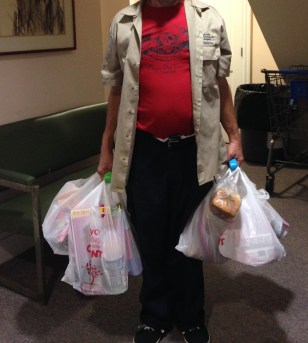 Yesterday we were able to offer one of our homeless clients the option of receiving food in a gently used backpack or plastic bags with the new Click and Carry handles. Once we showed him how the handles worked, his preference was for the handles. We gathered his food and packed the bags, making sure to pair some lighter bags with the heavy ones to give him a balanced load, both front and back and on each side. All in all, we were able to give him at least one third more food than we have been able to give homeless clients in the past. He was particularly happy to receive the handles, because he said the handles on the plastic bags dug uncomfortably into his hand after carrying them for a while. We sent him off happy and told him to give us some feedback on how well they worked the next time he was in for food.
 For over a year I have been troubled by the problem homeless clients, especially those on foot, present. We can not overcome some of the limitations that prevent us from providing our homeless clients with certain types of food. For instance, if they have no way to keep food refrigerated, we can not give them food that requires refrigeration. Similarly, if they do not have a means to cook food, we can not give them anything that requires even minimal cooking, like ramen noodles. One problem unique to providing food to homeless clients that I have felt we can solve, however, is limitation on the quantity of food we are able to give them at one time. The strategy to solving this problem involves a two-pronged approach–increasing the quantity and variety of food and nonfood items specifically for the homeless and coming up with solutions that allow homeless clients on foot leave with more food.
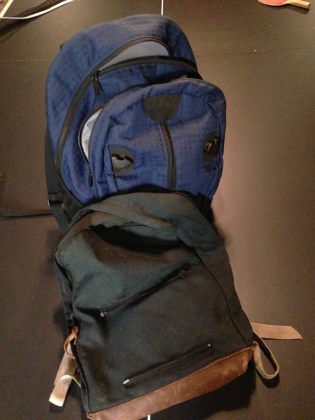 food homeless clients can take with them involves figuring out a way for them to carry more food away, so that their allotment more closely resembles the amount an individual with transportation is able to take. When packing food for a homeless client one of the questions we ask is whether s/he has a backpack. Backpacks can be packed with heavier items and to capacity, as it is easier to carry something heavy on your back. We have on occasion gotten backpacks donated, but do not always have them on hand for new homeless clients. Additionally purchasing new ones is cost prohibitive. Consequently, I starting searching for a more inexpensive alternative. We usually pack as much food for clients as we can in boxes, but that is not very practical for homeless clients on foot, so most of their items are put into plastic bags. Over time carrying multiple plastic bags in one’s hand can become uncomfortable or even painful if the bags are heavy, as anyone who has ever gone shopping at the mall can attest. Thinking about these mall trips made me remember a sales clerk who rigged up a handle that the other handles went through so that I was only having to carry one handle in my hand. She did this mostly so I didn’t drop a bag, but the result was also more comfortable to carry.
 I began searching the Internet for an item that could be fed through the handles of multiple bags and then closed, making one single handle to carry. What I found was
 For over 25 years on the Fourth of July weekend the local chapter of a motorcycle club pulls up outside the food pantry where I volunteer to deliver the results of their annual food drive. This year was no exception. On July 2nd three pickup trucks towing utility trailers loaded with food, diapers, personal hygiene products, cleaning products and paper products arrived, bringing the food pantry Christmas in July! During the month of June, members from Chester County A.B.A.T.E. set up outside local grocery stores on the weekends to collect donations for this drive. Additionally, club members take any financial donations they receive and purchase items the pantry
 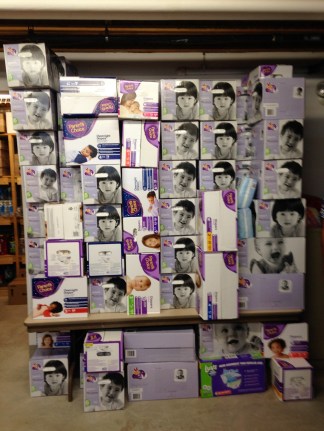 needs, but are not usually donated in a food drive, like the personal hygiene products, diapers and paper products.
 Operating a food bank, cupboard or pantry would be impossible without the generosity of those who donate. We are fortunate to get individual and organization donations regularly throughout the year. As a matter of fact, as I was leaving the pantry on Tuesday I held the door open for a lady bringing in a box of donated food. Additionally, several churches drop off regular donations from parishioners. Sizeable donations like this one, however, coming at a time of year when most people are focused on things other than food drives, help us better serve those in need in our community. So to the members of this motorcycle club I say a heartfelt thank you and safe ride!
![homeless-man-free-picture-for-blogs-1[1]](https://fromasimmertoaboil.com/wp-content/uploads/2016/04/homeless-man-free-picture-for-blogs-11.jpg?w=317&h=211) the homeless person sitting on the sidewalk or avoid making eye contact with the mother with the child who is asking for something to eat because he is hungry. Or worse, we look at them with disgust or harsh judgement. There are many reasons why we behave in this manner. Maybe we are frustrated because we are working hard and not getting ahead and we worry that one day that could all too easily be us. Or maybe we look away because we desperately want to be of assistance, but feel powerless to truly help these folks out of their situation. Some may tell themselves this homeless person or single mother is responsible for his or her situation due to the poor decisions he or she has made in life, and therefore deserves no further consideration. Whatever our rationale, the result of our actions is to push people living in poverty to the edges of society, to segregate them.
the homeless person sitting on the sidewalk or avoid making eye contact with the mother with the child who is asking for something to eat because he is hungry. Or worse, we look at them with disgust or harsh judgement. There are many reasons why we behave in this manner. Maybe we are frustrated because we are working hard and not getting ahead and we worry that one day that could all too easily be us. Or maybe we look away because we desperately want to be of assistance, but feel powerless to truly help these folks out of their situation. Some may tell themselves this homeless person or single mother is responsible for his or her situation due to the poor decisions he or she has made in life, and therefore deserves no further consideration. Whatever our rationale, the result of our actions is to push people living in poverty to the edges of society, to segregate them. snack cakes or sweets that are out of season, like the packaged peppermint bark we got right after Christmas. It is always fun slipping these items into a family’s monthly groceries, knowing the joy it will bring to a little one whose life holds few treats. This past week we were able to ensure a young girl got a birthday party thanks to someone who donated a birthday party in a bag, which included cake mix, birthday candles, plates and napkins. (What a great idea this is!) This young lady’s birthday party will be on Saturday and I will happily think of her getting to celebrate her birthday like a “normal” kid.
 This past Tuesday, rather than do my usual volunteering task of packing food for clients, I went and picked up the Panera bread and sweets that get donated to our pantry, since the lady who regularly makes this run is on vacation this week. I think a while ago I mentioned the bread we get from Panera, but for those who have not read that post let me explain. Once a week on Tuesdays the food pantry receives a delivery of breads and sweets that Panera Bread would otherwise throw away because they had not sold within Panera’s allotted time.
 find someone to come and take the bread, Panera would let her have it. She called all around the West Chester area and no one needed bread. While conducting this search, she made contact with the person who is the second leg of the relay. This lady knew about our pantry through one of our volunteers and asked us if we might be interested in this Panera bread if she brought it to us. Absolutely! And the relay was born–from a West Chester Panera to a business park in Wilmington, DE to a food pantry in rural Southern Chester County.
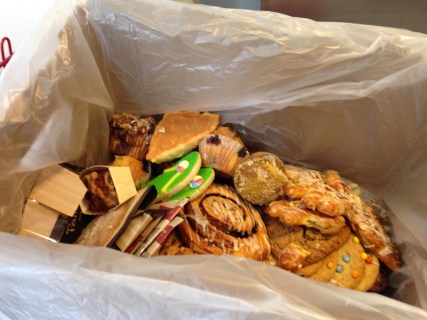 sweets as well, from Danish and scones to cookies and brownies to muffins and cinnamon buns. We get whatever didn’t sell. Once the bread and sweets get to us we package them for storing so they can be distributed throughout the week. I usually help with packaging the sweets. These we wrap individually in plastic wrap. We don’t get enough sweets to give to every household, so we save them for treats for clients who are experiencing an unusual hardship, like caring for someone who is ill or a grandmother raising her grandchildren. Most of what we receive is bread and the bread products get bagged to be frozen. A retired couple comes in on Tuesday afternoons to volunteer to do this task. The amount of bread we get each week determines how we distribute it. Usually we have enough to distribute something to each household, but sometimes when the delivery is small we use save the bread for large families to help augment their allotment. We also use this bread for our homeless clients when we can.
 him what we could, considering he didn’t have a refrigerator or any way to cook or warm his food. What we gave him was a mish mash and not much of it was very healthy. He said he would take anything we had to give, because he was really hungry. We gave him SPAM, Vienna sausages, sardines, saltines, granola bars, tuna fish, peanut butter and a couple tiny jars of jelly. We were also able to give him canned fruit, applesauce and beef stew and Chef Boyardee products (to be eaten cold). All of these items had to have pop tops or foil tops because he doesn’t have a can opener. Luckily we were able to give him some fresh grapefruit and apples. We were also lucky that someone had donated a package of plastic forks, so we were able to give him something with which to eat. He was fortunate to have a ride, which meant we were able to give him several bags of food. If he had been walking we would have only been able to give him what he could carry.
 So, what happens when employers do not pay their employees a living wage? Many of those employees are forced to turn to the government for assistance in the form of SNAP, Medicaid and housing and child care subsidies, forcing the U. S. taxpayer to make up the difference caused by their low wages. According to an article by
  that make many of our lives easier, like picking our produce, caring for our children or elderly and ailing parents or cleaning our office buildings. As
  From a Simmer to a Boil