 The year 2016 is coming to and end and what a year it has been. Before I take a few days off to enjoy Christmas and the New Year festivities with my family and friends, I wanted to reflect a bit on my journey assisting the food insecure this year. This past year contained some positive highlights. Nationally, the US Census Bureau reported in September that the poverty rate in the US declined in 2015 for the first time since 1999. In my community, the local school district started offering free lunch during the summer to all school age children in our community through the Summer Food Service Program. Online I found the Click and Carry handle, and with a generous discount from the manufacturer, was able to purchase several dozen to provide to our homeless clients, allowing them to carry away more food when they visit the food pantry. And finally this past month, due to the generous response of my blog readers, the food pantry was able to provide every household receiving food with a sweet treat baking mix–cookies, quick breads or brownies–to brighten their holiday. We were even able to offer aluminum baking pans to those who didn’t have a pan in which to cook the mix of their choosing. It
 was very rewarding to me and the other volunteers and staff who pack food for clients to see the happiness and excitement elicited by these unexpected treats. I want to extend a heartfelt thank you to all my friends, neighbors, family and readers who helped make this possible.
2016 also had it’s low spots. In Pennsylvania, the year started out without a budget negatively impacting a wide range of social services, from school districts to food pantries. When 2016 began, the state had been without a budget for over 180 days. Just before 2015 ended, Governor Wolfe announced he would line item veto the budget proposal sent to him by the General Assembly. Taking this action allowed $23.4 billion to be released, of which $18.4 million went to the State Food Purchase Program, which helps provide food to food pantries. In early Spring, the House GOP released a budget plan for fiscal year 2017 in which 62% of its proposed budget cuts came from low income, social safety net programs. Luckily this budget was not approved, but that is perhaps only a temporary reprieve from the ax for these programs, for 2016 came to a close with the election of Donald Trump for President after one of the nastiest Presidential campaigns I have ever witnessed.
I have heard many people say they are glad to see 2016 come to an end and it can’t end soon enough. I understand what they mean; unfortunately, I do not share their belief that next year will be better, especially with regard to those in poverty and experiencing food insecurity. There have been calls for the nation to come together, to work together, to address our nation’s challenges. I don’t have a problem with that sentiment, as long as that is what happens–both sides talking to each other and listening to each others’ concerns and proposals, then working together through compromise to reach a jointly crafted approach. I fear, however, that is not what is meant with the call for national unity. My concern is that what is being requested is for the nation to come together in support of the plans and proposals of the GOP, who will soon control the Legislative and Executive branches of the Federal Government and 33 Governorship (in 25 of those states they also control the State Legislature as well), with little to no dialogue or compromise taking place. If bipartisan compromise is not what is meant by the call to come together, I think the result will be unfortunate for all Americans. I guess we will just have to wait and see.
 So as 2016 comes to an end I am trying to remain that same optimist who has always tried to find the silver lining. Up until now, however, I never realized how close the colors sliver and gray were to each other. My husband keeps reminding me to focus on my sphere of influence–poverty, and in particular food insecurity–so as to not get overwhelmed by the magnitude of change that may be headed our way. It is good advice and I intend to try to follow it as best as I can. I will continue to advocate and do whatever else I can for those who are struggling to make ends meet and are experiencing food insecurity. I will also continue to encourage meaningful dialogue from all points of view with this blog. Thank you to my readers and to those who comment, either here on the blog or on Facebook or even in person. I have received inspiration, insight and encouragement from your words. And again, thank you so much to those who helped us brighten a few families’ holiday by donating baking mixes!
I wish all of you a wonderful holiday season and a happy, healthy New Year!

 Since Election Day I have wanted to write a post which addresses the social climate of the country, but was not sure how to approach the topic. I wanted my post to be constructive, not destructive or divisive. Every time I started to write, I felt like my personal frustration with the current social climate and its accompanying rhetoric got in the way of what I was trying to communicate. I wanted to add positively to the discourse without resorting to name calling and ugliness. The result was a virtual trashcan full of wadded up pieces of virtual paper. Part of the impediment was my own disappointment in the outcome of the election and my need to work through those feelings, a process akin to grieving. (Just call me Snowflake, even though I’m not a Millennial.) Then one day I heard a segment of a discussion between
  today’s social and political discourse. Instead, most parties participate in destructive disagreement, where the main point of the conversation seems to be to tear down or obstruct the opposing side at all costs. The result of this type of disagreement is gridlock and ill will toward fellow countryman.
 Similarly, shortly after moving to my current location, I started volunteering for my political party at the polls during election day. My political party is handily outnumbered by the other party in my township. That first election day a veteran volunteer from my party was introducing me to township members of my party as well as the other party. The atmosphere among all was very convivial and I was a bit confused, having learned at that point to view the other party as the enemy. This long serving political volunteer explained to me that we live in a small community and at the end of the day we are neighbors. We rely on each other and must work together if we hope to accomplish anything for our community. This was a revelatory statement to me, and while I have never stopped fighting for what I believe is the right path or agenda, I am also willing to listen to and engage in conversation with those who have differing viewpoints.
 Tuesday was Giving Tuesday and if I had been on the ball I would have written a post urging you to consider giving to your local food bank, pantry or cupboard. As it was, I took some time off for Thanksgiving and neglected to look ahead. Thinking I had missed a perfect opportunity I was a bit down when I realized Giving Tuesday was going to pass by without me being able to write a post about it. As I thought about my missed opportunity I became frustrated that giving was allotted one day out of 365 days in a year. Consequently, I decided that instead of throwing up my hands because I missed the opportunity to highlight Giving Tuesday, I would urge you to give on a Wednesday or Friday or whatever day works for you and to consider giving at other times of the year as well!
 organizations work to provide items for families in poverty to give to loved ones on Christmas morning. Finally, the cold weather necessitates added clothing, like winter coats, snow boots and hats and mittens, which are often well out of the monthly budget of families living near or below the poverty line.
 Every year my sister and I get together and bake Christmas cookies. It is one of my favorite activities over the holiday season. We light a fire in the fireplace and play Christmas carols all day. As the aroma of freshly baked cookies begins to waft through the house my kids and husband follow the smell to the kitchen to sample a still warm cookie or four. Many of these cookies will find their way to others as gifts–a little thank you to the mailman or the neighbors who can always be counted on for last minute items or pet assistance. The cookies spread cheer to my husband’s employees and the people who work at the agency that houses the food cupboard. As the rush and demands of the holiday season begin to encroach I always make sure I save a day for this event sometimes knowing that I will miss something else.
 like quick breads or brownies, especially ones geared for the holiday season, for instance gingerbread or pumpkin bread or brownies with seasonal add ins. I couldn’t find it in my grocery store, but I’m pretty sure Ghirardelli had a chocolate peppermint brownie mix out over the holiday season last year. Not every packaged mix will work, however. I am looking for mixes which only need the added ingredients of eggs, water and oil. These added items–eggs and cooking oil–are regularly provided by the pantry. I had initially been thinking of getting cookie mixes, but most of those require a stick of butter or margarine and many food insecure households just don’t have that luxury. I did find that the peanut butter cookie mix from Duncan Hines does not call for butter, so it is okay. Lastly, the donations must be mixes as opposed to slice and bake cookie tubes or frozen cookie dough, as we do not have the extra space to store items that need to be refrigerated or frozen.
 Think back to your worst, bad day. Nothing went right. Maybe you overslept and your car wouldn’t start or you missed your bus. Maybe you had an impossible task to complete for work or school. Maybe your boss was a jerk or your company was downsizing or you flunked out of college. Maybe the test results from the doctor were not good, for you or someone you love. There are countless ways you could have a worst, bad day.
 frustration or uncertainty you faced on that worst, bad day, you face most days of your life. Additionally, imagine that many of the coping mechanisms you used to get you through that worst, bad day are not available to you. You don’t have any friends or family who can help you in any way except listen or commiserate. You can’t afford to take time out for a mental health break. You do not have the money to treat yourself to ice cream, alcohol or a meal out and if you do decide, “What the heck! It’s been a really bad day and I deserve a treat.”, you are certain to experience disapproval from someone who does not feel you are deserving of that treat, even after a bad day. Welcome to the reality of someone living in poverty.
 condition the researchers called bandwidth poverty. When someone suffers from bandwidth poverty, s/he is spending most of his or her cognitive abilities figuring out how to put food on the table or pay bills and it becomes nearly impossible to think about the future and make long term plans. The study demonstrated that living in poverty created a mental stress that was equal to losing 13 IQ points, or stated another way, losing a whole night’s sleep. I have tried to function on little to no sleep and it was not easy. I can not imagine doing it day after day.
 as a person with bandwidth poverty will have less patience and a shorter attention span for their children. Long-term planning activities, like saving money, getting more education or searching for a new job decome too taxing to continue or cease to even be considered. Of course this pattern of behavior feeds right back into the negative stereotype that people in poverty make bad decisions, and are therefore, soley responsible for their situation. In reality, however, the effects of bandwidth poverty create an insidious cycle, trapping those living in poverty in a succession of bad decisions, because they are incapable of thinking about and planning for the future.
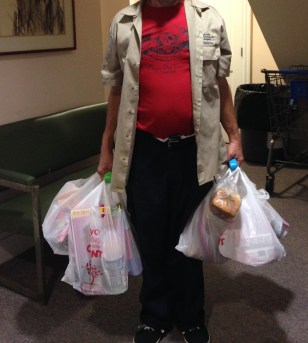 Yesterday we were able to offer one of our homeless clients the option of receiving food in a gently used backpack or plastic bags with the new Click and Carry handles. Once we showed him how the handles worked, his preference was for the handles. We gathered his food and packed the bags, making sure to pair some lighter bags with the heavy ones to give him a balanced load, both front and back and on each side. All in all, we were able to give him at least one third more food than we have been able to give homeless clients in the past. He was particularly happy to receive the handles, because he said the handles on the plastic bags dug uncomfortably into his hand after carrying them for a while. We sent him off happy and told him to give us some feedback on how well they worked the next time he was in for food.
 Recently I was reading through a Facebook conversation about whether someone who paid his or her fair share of federal income tax was less intelligent than someone who was able, through aggressive use of loopholes in the tax code, to avoid paying any federal income tax. (Don’t worry we aren’t going there.) One of the responders asked the original poster if he thought it would be better to keep as much of his money as possible so that he could personally give to organizations and causes he wanted to support, instead of having the Federal Government spend his money for him. The implication in his query is that our current Federal Government it too large and operates in an inefficient, even corrupt manner, wasting our hard earned money. The questioner believes the solution to this perceived problem is a smaller Federal Government, which can operate more efficiently, with less waste and corruption. This smaller Federal Government is able to exist because much of the services provided by the larger Federal Government have been delegated to the states, private sector or charities. Shrinking the size of the Federal Government is exactly what Speaker of the House, Paul Ryan, is trying to do when he advocates using charity as the solution to poverty. Using charities alone to solve a problem as large and as complex as poverty, is fraught with complications, however, and will never succeed in bringing about the desired result of lowering poverty rates.
 the inequities that inevitably arise from using this approach to solving a complex problem. These inequities are, for the most part not intentional, but nonetheless, exist and are very problematic. Donations will vary from geographic location to geographic location or for that matter from season to season. Consequently charitable organizations in one part of the country may be much better able to assist those in poverty than organizations located in other areas. Additionally, the amount of aid a charity can provide may vary throughout the year as giving fluxuates. Furthermore, donors elect to donate to causes that interest them, often times giving to the organization that has the more effective advertising campaign or hook, but that is not always assisting the greatest need. What results from relying on charities to solve the problem of poverty is an approach that is unequal on many levels and may even serve to exacerbate the problem in certain locations.
 The final and perhaps most important reason it is ill-advised to use charities to solve a problem as large and complex as poverty is that charities hinder or delay the social change and justice that must happen before any real progress in diminishing poverty can be seen. Donating to a charity fighting poverty distracts donors from fighting the inequities in society that cause poverty in the first place. The donor feels good, like s/he is making a difference in the overall problem, when really all s/he is doing is providing temporary relief. Furthermore, the act of providing temporary assistance often masks the true depth of these inequities. Those in need receive just enough to allow them to become complacent with their situation and to lessen the outrage they as well as the rest of society might otherwise feel. When you couple the complacency of the person in need with the sense of having helped of the donor, society fails to realize the true depth of the problem, and therefore, does not demand action to correct the inequities that allow the injustice to continue to exist.
 understands that charity alone will not solve the problem of poverty. The bishops have created
  For over a year I have been troubled by the problem homeless clients, especially those on foot, present. We can not overcome some of the limitations that prevent us from providing our homeless clients with certain types of food. For instance, if they have no way to keep food refrigerated, we can not give them food that requires refrigeration. Similarly, if they do not have a means to cook food, we can not give them anything that requires even minimal cooking, like ramen noodles. One problem unique to providing food to homeless clients that I have felt we can solve, however, is limitation on the quantity of food we are able to give them at one time. The strategy to solving this problem involves a two-pronged approach–increasing the quantity and variety of food and nonfood items specifically for the homeless and coming up with solutions that allow homeless clients on foot leave with more food.
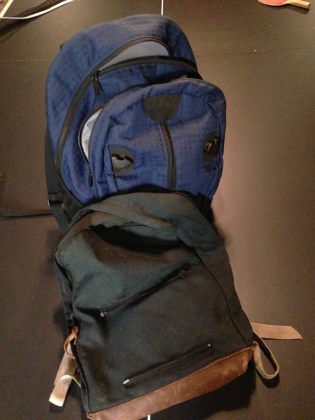 food homeless clients can take with them involves figuring out a way for them to carry more food away, so that their allotment more closely resembles the amount an individual with transportation is able to take. When packing food for a homeless client one of the questions we ask is whether s/he has a backpack. Backpacks can be packed with heavier items and to capacity, as it is easier to carry something heavy on your back. We have on occasion gotten backpacks donated, but do not always have them on hand for new homeless clients. Additionally purchasing new ones is cost prohibitive. Consequently, I starting searching for a more inexpensive alternative. We usually pack as much food for clients as we can in boxes, but that is not very practical for homeless clients on foot, so most of their items are put into plastic bags. Over time carrying multiple plastic bags in one’s hand can become uncomfortable or even painful if the bags are heavy, as anyone who has ever gone shopping at the mall can attest. Thinking about these mall trips made me remember a sales clerk who rigged up a handle that the other handles went through so that I was only having to carry one handle in my hand. She did this mostly so I didn’t drop a bag, but the result was also more comfortable to carry.
 I began searching the Internet for an item that could be fed through the handles of multiple bags and then closed, making one single handle to carry. What I found was
 large sums of money allocated by the Federal government to a regional government, usual states, for a specific program or project. Unlike other types of funding block grant funds come with few guidelines about how the funds are to be spent. Block grants are often touted as a way to run government more efficiently and save tax payer dollars. The belief being that these grants allow local governments, who know best how to use the grant money to help their citizens, have the flexibility to provide services or benefits in a more cost effective way. In theory, block grants sound like they might be just the way to help solve our budget deficit; however, theory and practice are often two different things.
 past 20 years, including during the Great Recession, reflecting a 28% loss in value. Another limitation of block grants, also tied to fixed funding, is their inability to respond to economic downturns, when more people may need assistance. Due to fixed funding, programs that are block granted are forced to try and help more people with the same amount of money, resulting in either a reduction of benefits or decline in the number of people able to be assisted. Finally, block grants are usually administered with very few guidelines and very little accountability as to how the funds are spent, allowing the potential for funds to be diverted to other purposes and the certainty that assistance provided under block granted programs will vary greatly from state to state.
 Budget Office projects SNAP caseloads will decrease from 45.8 million people in fiscal year 2015 to 33.1 million in 2026. Currently the program is run with little administrative costs and almost no fraud (<3% and most of that is on the part of the retailers, not the consumers). Not only does SNAP help the individuals that receive the benefit, but economist, Mark Zandi, states that a well funded SNAP program produces a positive ripple effect in the economy as SNAP benefits are put back into the economy, helping to pay the salary of the grocery store clerk, delivery truck driver and farmer. Changing the funding structure of the SNAP program, however, would alter much of what make this program a success. Why legislators would want to make such a change, that will in essence cripple the program, is difficult to understand. Unless maybe that is actually the plan. One hopes not.
 This past Saturday I spent the morning at a training session for a new program, sponsored by the Chester County Food Bank (CCFB), called Taste It!. I went to the training with another volunteer from the food cupboard. In addition to us, attendees included a few nutrition students from West Chester University, a representative from another food pantry and several individuals interested in volunteering with this program through the CCFB at various food pantries and at the Fresh2You Mobile Market. Volunteers with the Taste It! program prepare a nutritious recipe, provide samples of the prepared recipe and information about healthy cooking on a limited budget.
 overview of the program and proceedures, included a tour of the facility and a basic cooking and knife skills demonstration by a guest chef. We finished the training with hands on cooking of some of the recipes. The attendees were divided into 4 groups and prepared 4 different recipes provided by the Food Bank. Once completed we sampled all of the dishes and discussed the cooking process, our thoughts on the recipes and what we might discuss when presenting the recipe. For participating in the Taste It! program our food cupboard will receive a cooking kit, which includes bowls for ingredient display and mixing, measuring spoons and cups, a can opener, a cutting board, a knife, cooking utensils, a few basic ingredients like seasonings, oil, vinegar and soy sauce and an electric skillet for preparing the recipes. These items will facilitate the implementation of this program.
 From a Simmer to a Boil