Last week I was asked by a reader what determined poverty. She specifically wanted to know what criterion the government used to label someone as suffering from poverty. I answered her question briefly, but as I was doing so realized it would probably be beneficial to any reader as well as myself to explain how the government arrives at the Official Poverty Measure it publishes annually. In addition to explaining the formula and the history of how it came to be used, I will discuss some of the criticism, from liberals and conservatives, surrounding this measure, as well as the suggestions that have been  proposed in recent years to correct some of the faults associated with the Official Poverty Measure.
Every year the United States Census Bureau publishes poverty thresholds, which are a list of minimum level household incomes deemed adequate on which to exist. These thresholds measure pre tax cash income and vary based on family size, composition and age of householder. Any household with a gross annual income below the poverty threshold for a household matching its size and composition is considered to be in poverty. For my household, with a family unit of 4, two of which are children under the age of 18, the poverty threshold is $24,036. But where does that dollar figure come from?
In 1963 Mollie Orshansky, who worked for the Social Security Administration, was compiling a report on childhood poverty, but at the time no good system for measuring poverty existed. To help with her report Ms. Orshansky created a measurement using a set of nutrition guidelines established by the Department of Agriculture called the Economy Food Plan. The Economy Food Plan (now called the Thrifty Food Plan) was designed as an emergency use, short term cost guideline for families living on a meager budget. In 1955 the Department of Agriculture reported that the average American family spent one third of its income on food, so Orshansky took the dollar amount of the Economy Food Plan and multiplied it by 3 to arrive at the poverty threshold for a given household size. To this day, this is the method the U. S. Census Bureau uses to calculate annual poverty thresholds. The threshold is updated annually, however, for changes in the price of food using the Consumer Price Index.
Even though the United States government has been using Orshansky’s method for determining annual poverty thresholds for over 50 years, this system has been criticized by both liberals and conservatives. The first criticism centers on the use of the Economy Food Plan as the basis for establishing the poverty thresholds. The cost of food over the past 50 years has dropped and the average American household no longer spends one third of its income on food. Current estimates are that U. S. households spend only about 7% of their income on food. During the same time, the cost of other household expenditures, like transportation, has risen greatly. Another problem with relying on the Economy Food Plan as a basis for computing the poverty thresholds is that this guideline assumed the family would eat no meals outside of the home and that the household included a housewife who was a careful shopper and skilled cook who could stretch the family’s food budget as far as it could go. For any of a variety of reasons this scenario exists in few American households today.
The second area of criticism of this method for determining poverty numbers concerns how the annual household incomes are calculated and applied. When determining a household’s annual income, the Census Bureau uses that household’s gross annual cash income. Not included in that figure are any noncash benefits households might receive, like SNAP or housing subsidies. Additionally, the annual household income does not exclude household resources used for other non discretionary expenses, like tax payments, child support payments or out-of-pocket medical expenses, which can have a considerable impact on a household’s budget. Finally, these poverty thresholds are national numbers. In other words, they do not vary geographically, even though the cost of living can vary greatly from one location in the United States to another.
In 1992, after years of criticism of the method for measuring poverty, Congress asked the National Academy of Sciences to convene a group consisting of academics and policy planners to study the issue and make recommendations. The group, called The Panel on Poverty and Family Assistance, released its’ report, Measuring Poverty: A New Approach, in 1995. The panel recommended that the poverty threshold reflect the amount of money needed to meet a households’ basic needs for food, clothing, shelter and a little more for other necessary expenses. They stated that all resources available to meet the household needs should be counted, including noncash benefits like tax credits, SNAP and housing subsidies. Additionally, they recommended that any funds not available to meet the needs in the threshold, because they are to be used for other expenses like taxes, out of pocket healthcare costs or child support payments, not be counted as resources. Finally the panel’s report urged that the thresholds should vary geographically to reflect the differing costs of meeting the needs in the threshold that exist throughout the United States.
This report recommends addressing almost all of the major complaints expressed about  the poverty thresholds; however, for a decade and a half after the report’s release the panel’s recommendations were by and large ignored as neither Republican nor Democrat wanted to touch this political third rail topic. Finally, in 2011, the Obama administration started publishing a supplemental poverty measure (SPM) based largely on the recommendations of the NAS panel. The SPM is not the official measure of poverty and is not used when determining eligibility for poverty programs or allocation of funds for poverty programs; however it does give an alternative method to assess the status of low income American households. Like the poverty thresholds, the SPM is published annually. The report that accompanies the SPM data explains the difference between the Official Poverty Measure numbers and the SPM numbers, as well as discusses the effects of noncash benefits, taxes and other nondiscretionary expenses on the economic well being of low income households.
Using the Supplemental Poverty Measures for 2014, which are the most recent numbers available, the percentage of Americans in poverty is higher than the Official Poverty Measure report, 15.3 % and 14.9% respectively. What do either of these percentages tell us, really? The SPM is a step in the right direction; however, the problem with both the Official Poverty Measure and the SPM is that they are an absolute measure, a line. Make a dollar above the line and you are not considered to be in poverty, but your situation will likely not be any different than the person making $2 less than you who is considered to be below the poverty line. A line only provides economic data. It does not provide any information about what the person in poverty, or even just above the line, is experiencing, why he is there or show long he has been there. This information would be vital in formulating any plan to address poverty. To truly understand poverty, any measurement of it must encompass more than just a line. Consequently, the United States government should continue to strive for a more accurate assessment of poverty.
 For over 25 years on the Fourth of July weekend the local chapter of a motorcycle club pulls up outside the food pantry where I volunteer to deliver the results of their annual food drive. This year was no exception. On July 2nd three pickup trucks towing utility trailers loaded with food, diapers, personal hygiene products, cleaning products and paper products arrived, bringing the food pantry Christmas in July! During the month of June, members from Chester County A.B.A.T.E. set up outside local grocery stores on the weekends to collect donations for this drive. Additionally, club members take any financial donations they receive and purchase items the pantry
 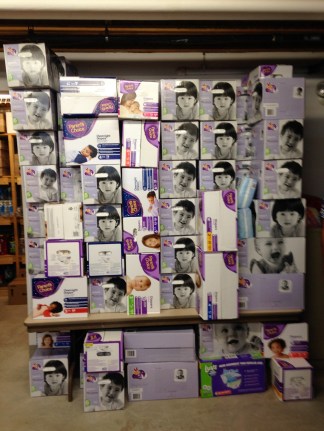 needs, but are not usually donated in a food drive, like the personal hygiene products, diapers and paper products.
 Operating a food bank, cupboard or pantry would be impossible without the generosity of those who donate. We are fortunate to get individual and organization donations regularly throughout the year. As a matter of fact, as I was leaving the pantry on Tuesday I held the door open for a lady bringing in a box of donated food. Additionally, several churches drop off regular donations from parishioners. Sizeable donations like this one, however, coming at a time of year when most people are focused on things other than food drives, help us better serve those in need in our community. So to the members of this motorcycle club I say a heartfelt thank you and safe ride!
![homeless-man-free-picture-for-blogs-1[1]](https://fromasimmertoaboil.com/wp-content/uploads/2016/04/homeless-man-free-picture-for-blogs-11.jpg?w=317&h=211) the homeless person sitting on the sidewalk or avoid making eye contact with the mother with the child who is asking for something to eat because he is hungry. Or worse, we look at them with disgust or harsh judgement. There are many reasons why we behave in this manner. Maybe we are frustrated because we are working hard and not getting ahead and we worry that one day that could all too easily be us. Or maybe we look away because we desperately want to be of assistance, but feel powerless to truly help these folks out of their situation. Some may tell themselves this homeless person or single mother is responsible for his or her situation due to the poor decisions he or she has made in life, and therefore deserves no further consideration. Whatever our rationale, the result of our actions is to push people living in poverty to the edges of society, to segregate them.
the homeless person sitting on the sidewalk or avoid making eye contact with the mother with the child who is asking for something to eat because he is hungry. Or worse, we look at them with disgust or harsh judgement. There are many reasons why we behave in this manner. Maybe we are frustrated because we are working hard and not getting ahead and we worry that one day that could all too easily be us. Or maybe we look away because we desperately want to be of assistance, but feel powerless to truly help these folks out of their situation. Some may tell themselves this homeless person or single mother is responsible for his or her situation due to the poor decisions he or she has made in life, and therefore deserves no further consideration. Whatever our rationale, the result of our actions is to push people living in poverty to the edges of society, to segregate them. snack cakes or sweets that are out of season, like the packaged peppermint bark we got right after Christmas. It is always fun slipping these items into a family’s monthly groceries, knowing the joy it will bring to a little one whose life holds few treats. This past week we were able to ensure a young girl got a birthday party thanks to someone who donated a birthday party in a bag, which included cake mix, birthday candles, plates and napkins. (What a great idea this is!) This young lady’s birthday party will be on Saturday and I will happily think of her getting to celebrate her birthday like a “normal” kid.
 The other day, as I sat down with my coffee to look over the morning’s news, the following headline caught my eye,
  contains proposals that will often negatively impact those it purports to assist. For instance, proposals in the plan seek to weaken nutrition standards for school lunches as well as reduce access to free meals for students in need, while raising administrative costs and burdens. Also proposed in the antipoverty plan is a shift to funding school lunches as a block grant. I find this particularly alarming, because block grants in the past often result in unequal access to programs nationwide and a decrease in benefits overall. Targeting the school lunch program for cuts is particularly troubling, as this program benefits children, a group most Americans agree should receive assistance. Additionally, the school lunch program has successfully lessened childhood hunger and ensured children are nutritionally prepared to meet their school day.
 The second concern I have with Ryan’s antipoverty plan is that while it seeks to reward being employed, the plan fails to address the minimum wage at all. Many Americans, including numerous people in Ryan’s own district, have lost good paying unionized manufacturing jobs as factories have closed and manufacturing jobs have moved oversees. When those who have found themselves unemployed find employment, what they find are often positions in the service industry which pays minimum wage. As I have said before, a full time minimum wage job barely keeps a single person without dependents above the poverty line, but someone with a family and that same job would certainly be in poverty with no chance to pull his or her family out of poverty on such a meager salary. For an antipoverty plan that champions working as the path out of poverty, to neglect to advocate for a living wage, or even a modest raise to the minimum wage is inexcusable.
 spirits were immediately lifted.
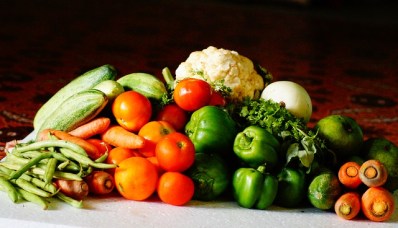 Food Bank of Delaware. The Food Bank of DE has received a 3 year grant from Giant Food’s Our Family Foundation. This grant allows the Food Bank of DE to partner with Delaware Pediatrics in a pilot program entitled “Produce Prescriptions”. The pilot will allow participating Delaware Pediatrics offices to identify up to 120 families they feel are at risk for food insecurity and diet related health conditions, such as cardiovascular disease, obesity and diabetes. Those families will then be given a “produce prescription” which allows them to receive a monthly allotment of 15-20 pounds of fruits and vegetables from the Food Bank. These fruits and vegetables will be able to be picked up by the families at the pediatric clinic they attend. What a great idea! I have read about doctors and hospitals writing prescriptions for fruits and vegetables, but this is the first program I have heard about that provides the produce to those who are otherwise unable to purchase the produce themselves.
 town, I am happy to know that I helped connect the Food Service Director with the right person at the right State agency to move the process along. I’d also like to think that keeping in contact with her over the past few months and letting her know that people in the community supported this action strengthened the district’s resolve to see this process to fruition. Either way, it matters not. The most important thing is that kids, who would otherwise be hungry, are now able to get a nutritious lunch 4 days a week over the summer.
 This past Tuesday, rather than do my usual volunteering task of packing food for clients, I went and picked up the Panera bread and sweets that get donated to our pantry, since the lady who regularly makes this run is on vacation this week. I think a while ago I mentioned the bread we get from Panera, but for those who have not read that post let me explain. Once a week on Tuesdays the food pantry receives a delivery of breads and sweets that Panera Bread would otherwise throw away because they had not sold within Panera’s allotted time.
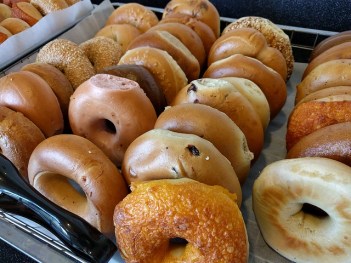 find someone to come and take the bread, Panera would let her have it. She called all around the West Chester area and no one needed bread. While conducting this search, she made contact with the person who is the second leg of the relay. This lady knew about our pantry through one of our volunteers and asked us if we might be interested in this Panera bread if she brought it to us. Absolutely! And the relay was born–from a West Chester Panera to a business park in Wilmington, DE to a food pantry in rural Southern Chester County.
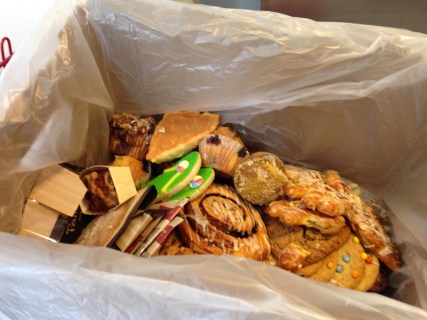 sweets as well, from Danish and scones to cookies and brownies to muffins and cinnamon buns. We get whatever didn’t sell. Once the bread and sweets get to us we package them for storing so they can be distributed throughout the week. I usually help with packaging the sweets. These we wrap individually in plastic wrap. We don’t get enough sweets to give to every household, so we save them for treats for clients who are experiencing an unusual hardship, like caring for someone who is ill or a grandmother raising her grandchildren. Most of what we receive is bread and the bread products get bagged to be frozen. A retired couple comes in on Tuesday afternoons to volunteer to do this task. The amount of bread we get each week determines how we distribute it. Usually we have enough to distribute something to each household, but sometimes when the delivery is small we use save the bread for large families to help augment their allotment. We also use this bread for our homeless clients when we can.
 I first started reading about these types of poverty, my assumption was that most people who lived in poverty as adults had grown up in poverty. In other words, that generational poverty was the most prevalent type of poverty in the United States. Historically this may have been the case and certainly in places like Appalachia, the deep South and many inner cities, people still suffer from generational poverty. Recent research, however, conducted independently by two professors, Stephen Pimpare currently at the University of New Hampshire and Mark Rank at Washington University, suggests that situational poverty is much more prevalent, and alarmingly, affects far more people than current Census Bureau poverty statistics reflect.
 With almost 40% of the population experiencing poverty for at least 1 year during the ages 25 to 60, the likelihood exists that most Americans know someone who has experienced poverty, or quite possibly have firsthand experience. The face of poverty today could very likely look like me or you. According to analysis of Census data done by the Brookings Institute, so far in the 21st century, more than two thirds of the increase in poverty rates have occurred in suburban households. In fact in 2013 suburban poverty levels exceeded urban areas. This dramatic rise in suburban poverty may surprise some, because unlike other types of poverty, suburban poverty is often hidden on tree-lined streets in developments that look just like mine.
 A group of alumni from my elementary school have been planning a reunion for all former students of this school. The school is no longer open, but when I attended it housed grades 1-4, one classroom for each grade. When my dad attended that same school it housed grades 1-8, with two grades per classroom, so as you can imagine the school was a small tight-knit community. Sadly, I will not be able to attend the reunion, but being included in the Facebook discussion about the reunion and memories of our little school and community has caused me to do a bit of reminiscing myself. Once we completed fourth grade and my class continued on to the much bigger middle school, I had fewer and fewer classes with many of my former classmates, and I lost track of many of them as the years passed.
 that, including the people who lived there. It is still called that today. Back in elementary school, my little person’s mind assumed it was called that because a large pit existed somewhere back in this wooded enclave of homes.
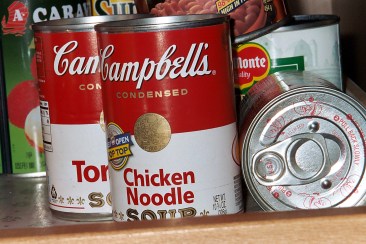 Tuesday my co-volunteer and I played “Would You Eat That Cold?” which is what we ask each other when we have to pack food for a homeless person who has no way of heating their food. This week we also played the companion games, “Is This Too Heavy to Carry?” and ” How Long Do You Think This Can Last Unrefrigerated?” These companion games were necessary because the homeless gentleman we were assisting was without transportation and could only take what he could carry. In addition, he lacked a refrigerator, cooler, or any other way to keep his food cold. As games go, these are not a very fun. This is the second time we have had to play them this month and at least the third time this year. Each time we have played them, it has been with a different person.
![homeless-man-free-picture-for-blogs-1[1]](https://fromasimmertoaboil.com/wp-content/uploads/2016/04/homeless-man-free-picture-for-blogs-11.jpg?w=351&h=233) poverty, which is defined as a period of being poor caused by situational factors like job loss, illness, divorce or natural disaster. While he may not have had many extras as a child and young adult, he did not live in poverty; however, due to situational factors like having to take care of his mother during her illness and current difficulty finding employment, he now finds himself homeless and living in poverty. If he could receive the necessary temporary assistance and find a permanent full time job that paid a living wage, so that he could begin to build a financial cushion, the likelihood exists that he would lift himself out of poverty.
poverty, which is defined as a period of being poor caused by situational factors like job loss, illness, divorce or natural disaster. While he may not have had many extras as a child and young adult, he did not live in poverty; however, due to situational factors like having to take care of his mother during her illness and current difficulty finding employment, he now finds himself homeless and living in poverty. If he could receive the necessary temporary assistance and find a permanent full time job that paid a living wage, so that he could begin to build a financial cushion, the likelihood exists that he would lift himself out of poverty. The reason for my hesitancy to move forward thus far stems from the fact that I’m not a risk taker, never have been. For me, as it probably is for most people, I haven’t taken risks because of a fear of failure. One of the things I really like about the Albion book is that it is peppered with motivational quotes, at least one on every page. Several of them deal with taking risks or overcoming the fear of failure. One of the ones that really caused me to stop and think is a simple statement from Wayne Gretzky:
 disturber,” which is a term Alan Webber, cofounder of the company and magazine Fast Company, coined to refer to himself. Albion quotes Webber, who describes his philosophy as such “Telling the truth for me was all about trying to make a difference by being honest about what I saw.” I plan to take this course of action, telling the truth about what I see and hoping it makes a difference. I believe that too many mistruths, exaggerations and bald faced lies have been told with regard to poverty, people struggling with poverty, the benefits they receive and the reasons these people are living in poverty. My intent is to stand up for and with those struggling with poverty, here in this blog as well as my everyday life, and without blame or belligerence tell the truth as I see it or experience it.
 From a Simmer to a Boil