The title of this blog post makes reference to a Latin phrase, Nihil de nobis, sine nobis (Nothing about us, without us) that has its origins in Central European  political traditions. This motto aided in the creation of Poland’s 1505 constitutional legislation, which transferred political power from the monarchy to parliament. It also sounds very similar to, and perhaps inspired the creation of, the American Revolutionary War demand “No taxation without representation!” More recently the phrase was used the 1990s in the disabilities rights movement. The ancient phrase expresses the equally age old notion of self-determination, that people want to control their own lives.
I just recently encountered the phase in a report entitled, Special Report: American’s Food Banks Say Charity Won’t End Hunger. The report is the result of a collaboration between WhyHunger and food access organizations that participated in the 2015 biennial Closing the Gap “Cultivating Food Justice” Conference. This conference, started by the Community Food Bank of Southern Arizona, brings together emergency food providers, who currently engage the entire community, including clients, to solve that community’s specific hunger problems. The Closing the Hunger Gap network’s stated purpose is “to engage food banks and their constituents in expanding their efforts beyond food handouts, toward community based empowerment initiatives that effectively network with broader food security work.” They envision a time when:
- food banks measure success, not by the increase in the number of people they help or the amount of food they distribute, but in how many people no longer need a handout.
- people, who now view themselves as recipients of food handouts, will be able to determine their own futures.
- low income people, food banks and community leaders work closely together to establish food security efforts that are not only national, but local and regional, in scope.
To accomplish their vision, these emergency food providers seek to move beyond being an organization that just distributes food (charity), to an organization that engages all of the community, including the poor, to work toward reducing poverty by addressing its root causes (social justice).
To aid in this shift, we must understand that the narrative we use when we speak about poverty is flawed. Mia Birdsong, in her TED Talk entitled, The Story We Tell about Poverty Isn’t True, actually suggests it is false. Toward the end of her talk, which highlights the innovative ways several people who are poor have solved problems facing them, Birdsong states,
I’m tired of the story we tell that hard work leads to success, because that allows…those of us who make it to believe we deserve it, and by implication, those who don’t make it don’t deserve it. We tell ourselves, in the back of our minds, and sometimes in the front of our mouths, “There must be something a little wrong with those poor people.” We have a wide range of beliefs about what that something wrong is. Some people tell the story that poor folks are lazy freeloaders who would cheat and lie to get out of an honest day’s work. Others prefer the story that poor people are helpless and probably had neglectful parents that didn’t read to them enough, and if they were just told what to do and shown the right path they could make it.
Neither story is correct and both prevent us from tapping into what Birdsong calls our “most powerful and practical resource. . .people who are poor.” Poor people are the experts on their problems and they probably see a solution to fix those problems. What is missing are the seed accelerators or venture capitalists, found in Silicon Valley and other places, who are willing to invest in the ideas of poor people. And I don’t mean just money. They need mentors, collaborators and people to open the right door. They need someone to listen to them and believe in them.
Let’s circle back to food banks and apply the new narrative that poor people quite often can create solutions to their own problems, provided they are offered the same help and encouragement that is offered to other segments of the population. What if the people  who run food banks invited some of their clients in to talk with them and other community leaders about the problems they are facing? And not just food related problems, but all of the problems they face. What if emergency food providers and other community leaders listened to them as they discussed their problems and believed they were the experts on their problems, including the solutions? What if after that meeting, clients, emergency food providers and community leaders collaborated, using the ideas of the clients coupled with the resources of the community, to address some of these problems? I think all parties involved would be surprised at what might be accomplished. I also think we would see stronger communities, as divisions decrease and understanding and respect grows.
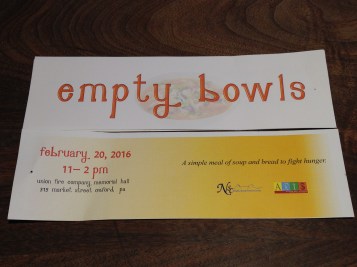
 available the day of the event as long as supplies last. Once the soup has been consumed, the bowl is yours to take home to serve as a reminder that hunger exists in our world.
 This past Saturday my family went to decorate our bowls, some more enthusiastically than others. (It’s hard to get enthusiasm out of teenagers sometimes!) We got our bowls, chose our color palette and got to work. We all had different styles and ideas. I had been stressing over what to paint, as I am not artistic at all. In the end, I decided it was best to keep it simple and went with stripes and polka dots. When these bowls are fired the colors will darken a bit. Since finishing our bowls we have all mentioned how excited we are to see our finished products. Check back after February 20th and I will have pictures of the fired bowls! There are two more Saturdays left to decorate bowls, so if you live in my community and are looking for a fun, creative, socially aware event to do with your family or just on your own, head on down to the Arts’ Alliance building and get a bowl of your own!

 Happy New Year and welcome to day 190 without a state budget here in Pennsylvania. If you are keeping track, and I am, that is just over half of the 2015-16 fiscal year without a budget and almost that long without any funds being released at all. Governor Wolfe’s refusal to approve of any stop gap funding in lieu of a passed budget came to an end just before 2015 did. On December 29 the Governor announced he would line item veto the state budget sent to him by the legislature. This action allows for $23.4 billion in emergency funds to be released. These funds will flow to school districts, human service agencies and county governments. Of that $23.4 billion, $18.4 million will go to the State Food Purchase Program. Through this program cash grants are awarded to lead agencies in each county, allowing them to buy items in bulk, which are then distributed to smaller emergency food providers–food pantries and cupboards–within the county.
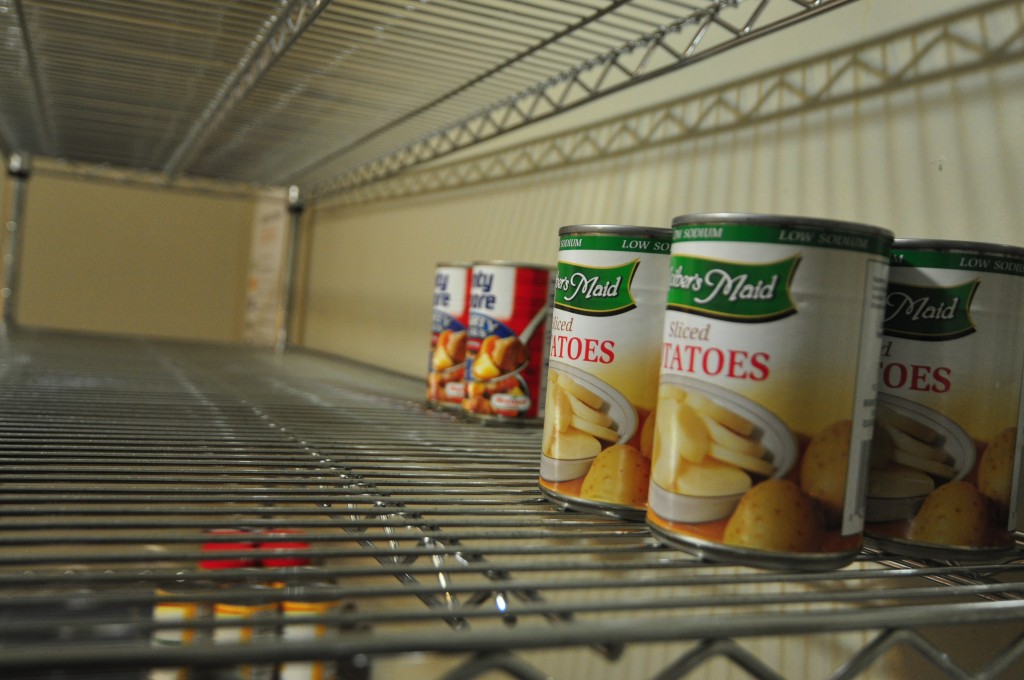
 volunteering at the local food pantry after having taken last week off. I was shocked at how empty the shelves were. We were down to just three types canned vegetables from our usual five or more. We had only one type of cold cereal or oatmeal instead of several selections of cereal, oatmeal, and pancake mix from which clients can choose. We had no spaghetti or dried beans and were almost out of rice, both white and brown.
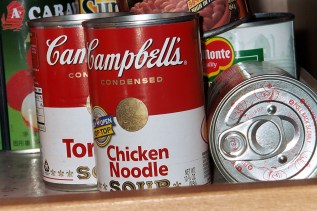 in these boxes, and while soup may seem like, and is, a good thing to donate to a food drive, canned soup contains an outrageous amount of sodium. Giving a client several extra cans of soup to make up for lacking items which could be used in meals clients prepare, like dried beans, means they are most certainly eating a more unhealthy diet this month.











 From a Simmer to a Boil