On the Brighter Side

bns and greensI just looked back over my posts so far, and while I am proud of what I read, the overall tone is a bit depressing.  Perhaps not surprising given the topic, but I also want to keep readers hopeful by reporting on successes and positive outcomes.  I have “liked” my county’s food bank on Facebook, and recently I have gotten a couple of posts from them on my news feed that have made me smile.  Today I will pass their upbeat posts on to you.  The food bank reported that in the past few weeks volunteers have peeled, cut and bagged 15,000 lbs. of butternut squash.  I love butternut squash and am excited to see so much of it being offered in our local food bank and pantries.  They additionally released the amount of venison they received this year from Hunters Sharing the Harvest–3,000 lbs.  As someone who regularly dodges deer as they dash across the road, I am glad this successful program is in place.  Finally, on this St. Patrick’s Day, the food bank posted that the spring greens have been planted in their local greenhouses!  I look forward to seeing those greens as they are distributed to the food pantries in the coming months.

family cooking

I am very encouraged and pleased fresh produce and unprocessed meat is being offered in our local food bank and pantries.  I will explain why over the next few weeks as I publish a series of posts about cooking.  This series will be at least three parts.  I will be discussing the decline in cooking in the United States, and by cooking I mean from scratch.  I also will explain why I think it is important to cook from scratch whenever possible and how cooking from scratch is beneficial to those experiencing food insecurity.  Finally, I will address how I think the decline in cooking is often unintentionally aided by food banks and pantries and propose some ideas they can use to combat this decline.

This series will take a bit of research and careful thought, so stay tuned over the next couple of weeks as I formulate and publish these related posts.  While I always welcome comments, this topic is one area where I really want to hear what others think.  I realize there will be some challenges and hurdles to overcome in what I am proposing, so I need help in looking at the topic from several points of view.   In the meantime, find some time to dust off some of your favorite recipes or find some new ones and cook something!

Homeless in Winter

freezing thermometerIn the past week in southeastern Pennsylvania it has snowed twice, once with a topping of freezing rain and sleet.  Last Friday morning the temperature with the wind chill was between -10 and -15 degrees.  The coldest weather this area has seen in 50+ years.  This morning it was 1 degree without the wind chill.  When people meet in public the topic is how cold it is and how ready everyone is for Spring to get here.

This morning at the food pantry I met Bill (not his real name).  He is ready for Spring to come too.  Bill is homeless and lives in a tent.  He knows exactly how cold it has been and what type of precipitation has been falling from the sky.  Twice his tent has collapsed on him from the weight of the snow.  He has a kerosene heater, but no kerosene.  Bill keeps warm with and cooks over an open fire.  He has been given permission to “camp” within the patrolled area of a local food manufacturer’s property because his tent has been burglarized more than once.  What little money he has, Bill makes from selling firewood, otherwise he has no income.  He cleans a friend’s home in exchange for her driving him places and allowing him to store items, like eggs, in her refrigerator.

His homeless situation presented us with challenges in gathering his food.  First we had to make sure he had gotten a ride, which he luckily had.  Otherwise he could only take what he could carry.  The other volunteer working with me today knew of Bill’s situation, so she knew he could only have cans and only ones with a pop tops.  He needs cans because he can put them right in his fire to warm them and pop tops because his can opener has been stolen twice.  The extreme temperatures make keeping liquids problematic for him.  He does have a cooler but he said the water he had, had frozen solid the other day even in the cooler.  In spite of these challenges, we were able to send Bill on his way with several items.

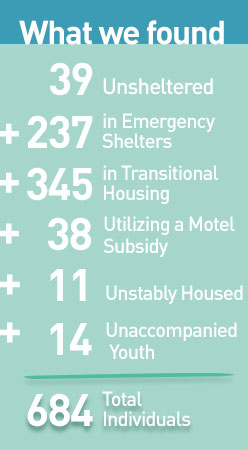
D2D-PIT-CallOut-2014According to a Point-in-Time count conducted on January 29, 2014, 684  people were experiencing homelessness on that night here in Pennsylvania’s wealthiest county.  Point-in-Time counts are used to help determine how many people are experiencing homeless on any given night in an area.  This figure includes those in emergency shelters, transitional housing, receiving motel subsidies and, like Bill, unsheltered.  Even if Bill had wanted to come in out of the cold, there are no shelters in our corner of this county.  The nearest ones are 25-30 miles away.

I would have not been surprised if Bill had been bitter or angry, but he was not.  He said he had too much to do to think about being cold, but he lingered with us as long as he could.  It is forecast to be below average in temperature for at least the next week.  Tonight, as I get into my bed with flannel sheets and three blankets, I will think about Bill and hope that he is okay.  At least I know he won’t be hungry.

Who’s in the Pantry?

As I mentioned in an earlier blog post, I have seen young and old, men and women and several different ethnic groups using the two food banks where I volunteer.  I now want to try and flesh out how many people are using food pantries and some of the reasons they find themselves there. I will mostly be using statistics from Pennsylvania and/or the county in which I live.

According to statistics from the USDA, 49.1 million Americans, or 14.3%, live in a food insecure household.  These residents do not consistently have access to the necessary food needed to lead an active, healthy life.  Pennsylvania’s food insecurity rate falls below the national average.  State of Hunger: Pennsylvania 2013, a document prepared by the Coalition Against Hunger, states that 1.6 million Pennsylvania residents, or 1 in 8, are food insecure.  In my county the food insecurity rate is 10% in general and 14% for children.  While not everyone who is food insecure uses a food pantry or soup kitchen, the State of Hunger:  Pennsylvania 2013 report states that 105,044 county residents (503,897 total county population) participated in the State Food Purchase Program which provides food to charities, like food pantries, who help feed low income residents.

That’s a lot of people.  Each person who uses a food pantry has his or her own personal story of how they became food insecure.  Most clients of a food pantry come because they have little choice.  For many, they only go to the food pantry when their Supplemental Nutrition Assistance Program (SNAP) benefits have run out.  According to the USDA, the average monthly household SNAP benefit for Pennsylvania residents in 2014 was $241.05.  This benefit amount has declined every year in Pennsylvania since 2011 and it is projected to decline even more in 2015.  When those meager dollars run out, many turn to the local food pantry to help close the gap.  While volunteering, I have noticed it is busier at the end of the month than it is at the beginning when SNAP benefits are distributed.

With the cuts in SNAP benefits, less and less people qualify for the program.  In my county, 25,614 residents participated in SNAP in April 2014 or 5% of the county population.  The county’s food insecurity rate is 10%, meaning that approximately half of the county’s food insecure are not receiving benefits.  Currently to qualify for SNAP benefits your gross monthly income needs to be at or below 130% of poverty.  It is accepted, however, that families need an income at or above 200% of poverty just to make ends meet.  As you can see, there is a huge gap between the income that qualifies someone for SNAP benefits and what that person really needs to survive.  People falling into that gap are certainly coming to the food pantry.

If all these numbers and words don’t help you put a face on who is using food banks, I encourage you to watch a powerful documentary called A Place at the Table.  A companion book by the same name was also published.  This movie focuses on the experiences of three Americans struggling with food insecurity.  You can stream it live from Amazon Prime or Netflix.

Two things stuck with me from this movie.  The first is the following quote from Jeff Bridges.

35 million people in the U.S. are hungry or don’t know where their next meal is coming from, and 13 million of them are children. If another country were doing this to our children, we’d be at war.

The second item that has stayed with me is the fact that we almost ended hunger in America in the recent past.  In 1969 President Nixon declared war on hunger and called for governmental action to end hunger in America.  In response funding was increased for existing programs and new programs, like the Special Supplemental Food Program for Women, Infants and Children (WIC), were created.  Within a decade hunger in the United States was almost eradicated.

We have tackled this problem before and almost succeeded.  I am saddened that we have allowed so much ground to be lost over the last few decades, but I also have hope that Americans can once again rise to the challenge and eliminate hunger in the United States.  I choose to focus on that hope.

What’s in the pantry?

In 1980 200 food banks existed in the entire United States.  Today there are over 40,000 food banks, pantries and soup kitchens.  With all the recent cuts in the Supplemental Nutrition Assistance Program (SNAP, formerly called the Food Stamp Program) food banks are doing the heavy lifting in ensuring those who are hungry get the food they need.  Food banks were once considered a place to turn in an emergency, for a little while.  Now they are a necessity to many.  So how do food banks work?

Individual food banks are often networked together with other food banks and coordinated at the county or state level.  State and Federal resources are then funneled from the parent organization to each food pantry in the network.  The individual food banks serve local areas often defined by a local government jurisdiction or school district boundaries.  They have set hours each week when clients can come get their food.  Clients are allowed to come once a month to receive a full allotment of groceries, but often the pantry will allow clients to come weekly to get donated bread/baked goods and perishable items like fresh produce when available.

Most of the food at food banks comes not from donations, but from State and Federal food distribution programs.  The Federal program, The Emergency Food Assistance Program (TEFAP), provides USDA purchased commodities and has been in existence since 1981.  The State Food Purchase Program supplements TEFAP by providing funds to food agencies.  These agencies buy food in bulk and then distribute it to the food banks in their network.  These two programs provide the majority of food distributed by food pantries.

food driveFood banks and pantries, however,  receive food other ways.  Who hasn’t given a donation to a local organization sponsoring a food drive.  I have sent food in to my kids’ schools and every year a Boy Scout troop distributes empty bags in our neighborhood one week and comes back to collect the filled bags the next week.  Right now (not long after the winter holidays) one food pantry in which I volunteer is still sorting through boxes of food donated during the holidays.

breadBoth of the food pantries I am familiar with get large weekly donations of bread/bakery products.  A staff member at one pantry goes to a local grocery store and takes all the bakery items the store can no longer sell and was going to throw away.  The other pantry has a volunteer who picks up similarly expired bread products from a local chain restaurant that specializes in sandwiches.  In both pantries these items are frozen to be distributed to clients through the week.

produceFood banks and pantries have learned to capitalize on what is unique or abundant in their area.  For instance here in rural Pennsylvania, we have many farmers.  In the summer when produce is plentiful, sometimes too plentiful (zucchini again?!) farmers can donate their extra produce to the food bank.  In addition to taking donations of produce, the main county food bank has partnered with local farmers who grow produce for the county food bank network.  That produce is then distributed to the food banks in the network who are able to take it.  Additionally, food pantries that have the land available grow their own produce in garden plots and/or raised beds.

Finally, living in rural Pennsylvania there are many hunters and many more deer.  Our county food bank participates in a statewide program called Hunters Sharing the Harvest.  Hunters can donate their deer to a participating butcher for processing.  The food bank picks up the processed venison and distributes it to the participating local pantries.  I think this is a  great win win situation–hunters are helping those in need and controlling the deer population.

doe

Here are some links to websites I found helpful and informative

I encourage you to take a look at what is happening in your area.  Is there a way you can help?  Often food banks have a list of items most needed.  Next time you donate to a food drive, find out what is most needed.  I’d love to hear of any innovative programs offered by other food banks.