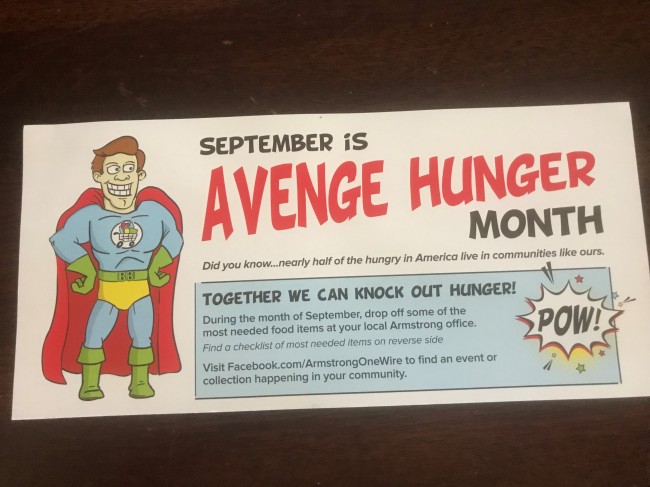
This insert came in my last month’s cable bill from Armstrong, our local cable provider. The insert alerts Armstrong’s customers about a food drive, benefiting local food banks and soup kitchens. They are sponsoring this food drive during the month of September as part of Feeding America’s Hunger Action Month. The nonprofit organization, Feeding America, started Hunger Action Month in 2008, in an effort to increase involvement nationwide in the fight against food insecurity in the United States. On their website, Feeding America urges Americans to stand up and Pass the Plate, by pledging to take some action to end hunger and then sharing that pledge with friends and family. The web page has a drop down menu of actions from which you can choose–donate, volunteer, contact legislators–or you can write in your own actions.
I like the idea, evoked by my cable company’s flyer, of inflicting harm on hunger on behalf of those who are hungry, and that this campaign will help individuals locally. I also support the call to action encouraged by Feeding America, and that they provide more than one suggestion for how the general population can fight hunger. One person may volunteer because he lacks the extra money to donate. Another may donate money to an organization like Feeding America or items to a food drive, because she lacks the time to volunteer. Charitable organizations who work tirelessly to assist those who are food insecure need both of these people and the resources they bring to bear in the fight against hunger. But the one action we all must must take is the third option provided in the drop down menu–contact our legislators.
The reason all those participating in this Pass the Plate campaign must engage their legislators, at all levels, is because non-profit organizations, all of them combined, can not feed all of the hungry in America. Nor can a cable company avenge hunger. Hunger and food insecurity in the United States is as formidable a foe as any of the Avengers has ever faced. As I have written before, charitable organizations alone can not solve this problem. At best they can provide stop gap measures which only serve as a band-aid on the problem. To really tackle hunger in America requires a strong social safety net and legislation which addresses the root causes of poverty in our country. So continue to volunteer and donate, as what you give enables charitable organizations to provide the stop gap measures those who are hungry need immediately, but also take the time to contact your legislators to insist that the programs which strengthened our social safety net be enacted and that steps be taken to address the root causes of poverty in America. Only then can we truly avenge hunger.

 The other day, as I was scrolling through my Facebook feed, I came across a reposted blog entitled
  advantage of you and/or the system.
 In addition to being non-judgmental and compassionate, however, we try to offer kindness and restore a little bit of dignity to those who are struggling daily with the weight of poverty. When we learn about a client facing a particularly difficult situation, we try to brighten that person’s day. For the grandmother who is raising some of her grandchildren or the caretaker of an ailing family member, we try to slip in a brownie mix or some other special treat if we have them. We keep on hand some birthday gift bags filled with all the fixings for a birthday party for households where a child is celebrating a birthday, but there is no money for a celebration. For clients who are cancer patients we give scented lotions and soaps donated from a local store when they rotate their stock. I can tell the aim of offering these niceties is successful in lessening the burden of shame these people carry by the look on the recipient’s face and the thank yous, often said repeatedly, we receive when we let them know about the item. And this is why I have chosen the items I have for my food drives. I wanted to pick things which would be a treat and would, if only for the amount of time it takes to drink a cup of coffee, allow someone in poverty to put down the weight of shame society has asked them to carry and and live like a person worthy of dignity.
 As one year comes to a close and another opens, full of possibilities and potential, it is only natural to reflect on what has transpired over the past year, and to look forward and plan for the upcoming year. Many set resolutions for themselves based on goals they wish to attain, and others start new ventures. I am no different than most. This morning I made friends with my treadmill again and started logging my daily water intake, in hopes maintaining a better level of hydration. I have not limited my reflections and resolutions to just my personal life, however. As a result of stepping away, over the past year, from my bi-monthly schedule of locating, researching, and writing posts about interesting and informative topics concerning poverty and food insecurity, I have been able to think about what I hope to accomplish by writing the blog, to what degree I have been successful, and what, if any, changes need to be made. Consequently, I have decided to introduce monthly narratives about people I encounter as I assist those who are experiencing food insecurity.
 frequently experienced when talking with others about poverty, especially with regard to public assistance. The comments causing my frustration concern the questioning of the deservedness of those who receive any form of public assistance, whether that assistance is welfare (TANF), food stamps (SNAP) or food from a food pantry. I’ve heard individuals classify those receiving assistance as lazy and living off the hard work of taxpayers or as illegal immigrants who have only come to the United States to get a handout. Running through all of these comments is the theme that those in poverty are at fault for their situation, should feel shame, and any help they receive should carry a punitive component. Over the past few years of writing this blog, I have presented statistics and facts about the average individual receiving assistance in an attempt to educate those who make such statements as to who the typical individual receiving public assistance is and the typical circumstances causing his or her need. Unfortunately, I do not think I have made much headway in convincing those critical of public assistance that the majority of those receiving it are truly deserving.
 Refusing to give up, I have used my time away from writing to think about another strategy I can use to encourage these folks to stop and consider the possibility that the majority of individuals receiving public assistance are in dire straits, are working as hard as they can to get out of their situation, and do deserve the assistance they are receiving during their time of need. As I have engaged others in a dialogue about poverty and the deservedness of those receiving public assistance, I have noticed that quite often the individual questioning the legitimacy of those in poverty to receive assistance is familiar with a person or family’s story which demonstrates for them genuine, legitimate need. Those critical of public assistance give a pass to the individuals in these cases. As a result of this observation, I have decided to write each month about a real person who is struggling with poverty and food insecurity, and whose story will hopefully give pause to someone who doubts the necessity of a strong social safety net in the United States. For these monthly narratives, I intend to draw on firsthand encounters
 Being involved in a food pantry during the holiday season results in a seesawing of emotions for me. I have more than once found myself leaving a volunteer shift in low spirits over the holiday season. Hearing the stories of individuals and families who find themselves in such heartbreaking and often desperate situations is extra difficult when the balance of your life is filled with thoughts of and plans for the gastronomic bounty that is Thanksgiving and the excitement of giving and receiving that comes with Christmas. The juxtaposition of these two very different life situations can leave me filled with a combination of anger, sadness and helplessness.
 she will provide Christmas presents for her children, but how she will feed them dinner on Christmas Day. And I can not begin to explain to you the look of excitement and joy I saw on the faces of several young children as they picked out the sweet treat we gave out last December.
 would result in a huge loss for Chester County’s Meals on Wheels program, as 35% of their budget comes from government contracts.
 Every year my sister and I get together and bake Christmas cookies. It is one of my favorite activities over the holiday season. We light a fire in the fireplace and play Christmas carols all day. As the aroma of freshly baked cookies begins to waft through the house my kids and husband follow the smell to the kitchen to sample a still warm cookie or four. Many of these cookies will find their way to others as gifts–a little thank you to the mailman or the neighbors who can always be counted on for last minute items or pet assistance. The cookies spread cheer to my husband’s employees and the people who work at the agency that houses the food cupboard. As the rush and demands of the holiday season begin to encroach I always make sure I save a day for this event sometimes knowing that I will miss something else.
 like quick breads or brownies, especially ones geared for the holiday season, for instance gingerbread or pumpkin bread or brownies with seasonal add ins. I couldn’t find it in my grocery store, but I’m pretty sure Ghirardelli had a chocolate peppermint brownie mix out over the holiday season last year. Not every packaged mix will work, however. I am looking for mixes which only need the added ingredients of eggs, water and oil. These added items–eggs and cooking oil–are regularly provided by the pantry. I had initially been thinking of getting cookie mixes, but most of those require a stick of butter or margarine and many food insecure households just don’t have that luxury. I did find that the peanut butter cookie mix from Duncan Hines does not call for butter, so it is okay. Lastly, the donations must be mixes as opposed to slice and bake cookie tubes or frozen cookie dough, as we do not have the extra space to store items that need to be refrigerated or frozen.
 For over a year I have been troubled by the problem homeless clients, especially those on foot, present. We can not overcome some of the limitations that prevent us from providing our homeless clients with certain types of food. For instance, if they have no way to keep food refrigerated, we can not give them food that requires refrigeration. Similarly, if they do not have a means to cook food, we can not give them anything that requires even minimal cooking, like ramen noodles. One problem unique to providing food to homeless clients that I have felt we can solve, however, is limitation on the quantity of food we are able to give them at one time. The strategy to solving this problem involves a two-pronged approach–increasing the quantity and variety of food and nonfood items specifically for the homeless and coming up with solutions that allow homeless clients on foot leave with more food.
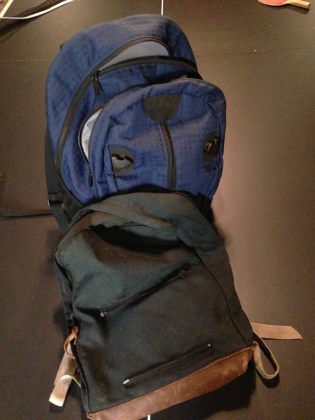 food homeless clients can take with them involves figuring out a way for them to carry more food away, so that their allotment more closely resembles the amount an individual with transportation is able to take. When packing food for a homeless client one of the questions we ask is whether s/he has a backpack. Backpacks can be packed with heavier items and to capacity, as it is easier to carry something heavy on your back. We have on occasion gotten backpacks donated, but do not always have them on hand for new homeless clients. Additionally purchasing new ones is cost prohibitive. Consequently, I starting searching for a more inexpensive alternative. We usually pack as much food for clients as we can in boxes, but that is not very practical for homeless clients on foot, so most of their items are put into plastic bags. Over time carrying multiple plastic bags in one’s hand can become uncomfortable or even painful if the bags are heavy, as anyone who has ever gone shopping at the mall can attest. Thinking about these mall trips made me remember a sales clerk who rigged up a handle that the other handles went through so that I was only having to carry one handle in my hand. She did this mostly so I didn’t drop a bag, but the result was also more comfortable to carry.
 I began searching the Internet for an item that could be fed through the handles of multiple bags and then closed, making one single handle to carry. What I found was
 This past Saturday I spent the morning at a training session for a new program, sponsored by the Chester County Food Bank (CCFB), called Taste It!. I went to the training with another volunteer from the food cupboard. In addition to us, attendees included a few nutrition students from West Chester University, a representative from another food pantry and several individuals interested in volunteering with this program through the CCFB at various food pantries and at the Fresh2You Mobile Market. Volunteers with the Taste It! program prepare a nutritious recipe, provide samples of the prepared recipe and information about healthy cooking on a limited budget.
 overview of the program and proceedures, included a tour of the facility and a basic cooking and knife skills demonstration by a guest chef. We finished the training with hands on cooking of some of the recipes. The attendees were divided into 4 groups and prepared 4 different recipes provided by the Food Bank. Once completed we sampled all of the dishes and discussed the cooking process, our thoughts on the recipes and what we might discuss when presenting the recipe. For participating in the Taste It! program our food cupboard will receive a cooking kit, which includes bowls for ingredient display and mixing, measuring spoons and cups, a can opener, a cutting board, a knife, cooking utensils, a few basic ingredients like seasonings, oil, vinegar and soy sauce and an electric skillet for preparing the recipes. These items will facilitate the implementation of this program.
 For over 25 years on the Fourth of July weekend the local chapter of a motorcycle club pulls up outside the food pantry where I volunteer to deliver the results of their annual food drive. This year was no exception. On July 2nd three pickup trucks towing utility trailers loaded with food, diapers, personal hygiene products, cleaning products and paper products arrived, bringing the food pantry Christmas in July! During the month of June, members from Chester County A.B.A.T.E. set up outside local grocery stores on the weekends to collect donations for this drive. Additionally, club members take any financial donations they receive and purchase items the pantry
 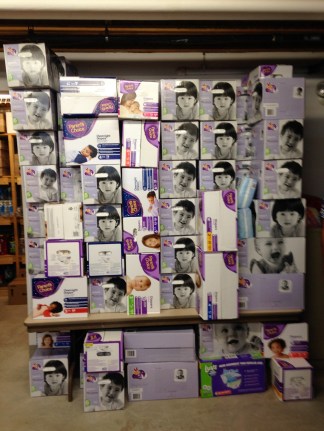 needs, but are not usually donated in a food drive, like the personal hygiene products, diapers and paper products.
 Operating a food bank, cupboard or pantry would be impossible without the generosity of those who donate. We are fortunate to get individual and organization donations regularly throughout the year. As a matter of fact, as I was leaving the pantry on Tuesday I held the door open for a lady bringing in a box of donated food. Additionally, several churches drop off regular donations from parishioners. Sizeable donations like this one, however, coming at a time of year when most people are focused on things other than food drives, help us better serve those in need in our community. So to the members of this motorcycle club I say a heartfelt thank you and safe ride!
 spirits were immediately lifted.
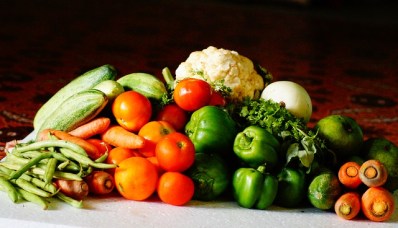 Food Bank of Delaware. The Food Bank of DE has received a 3 year grant from Giant Food’s Our Family Foundation. This grant allows the Food Bank of DE to partner with Delaware Pediatrics in a pilot program entitled “Produce Prescriptions”. The pilot will allow participating Delaware Pediatrics offices to identify up to 120 families they feel are at risk for food insecurity and diet related health conditions, such as cardiovascular disease, obesity and diabetes. Those families will then be given a “produce prescription” which allows them to receive a monthly allotment of 15-20 pounds of fruits and vegetables from the Food Bank. These fruits and vegetables will be able to be picked up by the families at the pediatric clinic they attend. What a great idea! I have read about doctors and hospitals writing prescriptions for fruits and vegetables, but this is the first program I have heard about that provides the produce to those who are otherwise unable to purchase the produce themselves.
 town, I am happy to know that I helped connect the Food Service Director with the right person at the right State agency to move the process along. I’d also like to think that keeping in contact with her over the past few months and letting her know that people in the community supported this action strengthened the district’s resolve to see this process to fruition. Either way, it matters not. The most important thing is that kids, who would otherwise be hungry, are now able to get a nutritious lunch 4 days a week over the summer.
 From a Simmer to a Boil